Rationale: Cannabis is the most frequently used psychoactive drug during adolescence and adulthood (United Nations Office of Drugs and Crime, 2018). Most states that have legalized cannabis have set the minimum age at 21. However, despite these legal age restrictions, more than one-third of US high school seniors report using cannabis in the past year.
Cannabis use during adolescence is especially concerning because it is a crucial period for brain development. Most brain regions are developing until the age of 25, with some developing faster than others.
Using cannabis during key developmental periods causes structural changes to the brain. This has been linked to maladaptive mood and behavioural symptoms, which puts oneself at an increased risk of using other drugs later in life. One of the main brain structures in development during adolescence is the cerebral cortex. This area allows for higher-level thinking, such as making decisions, speaking, problem solving, and learning (Johns Hopkins, n.d.). Previous research suggested that using cannabis during teenage years might speed up natural thinning in the outer layer of the brain, especially in the prefrontal cortex, which controls mood, memory, and decision-making. (Albaugh, 2021). This leads scientists to wonder if different periods of cannabis initiation will have lasting impacts on brain structure.
Method: This study was conducted across 8 European sites. 704 teens were grouped into three categories: those who never used cannabis (“Cannabis Naive”), those who started between ages 14-19 (“Adolescent Initiators”), and those who started between ages 19-22 (“Young Adult Initiators”). They were followed for ten years.
Participants completed periodic assessments of drug use using The European School Survey Project on Alcohol and Drugs (ESPAD), which is a self-reported substance use survey. Psychopathology was measured using The Community Assessment of Psychic Experiences (CAPE), which is a self-report questionnaire to measure the likelihood of psychosis in the general population. This was administered at ages 19 and 22. The self-report of the Strengths and Difficulties Questionnaire (SDQ) was used to assess mood and anxiety symptoms of students under the age of 19. Finally, using anatomical MRIs, cortical thickness was measured at ages 14, 19, and 22.
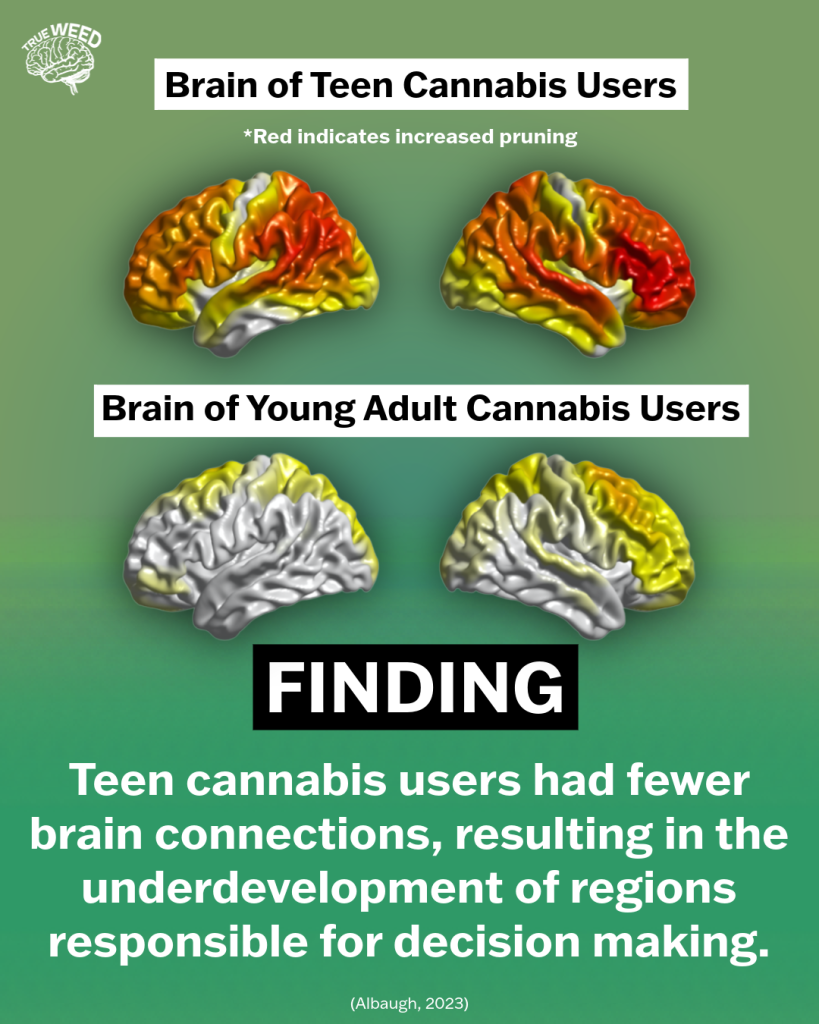
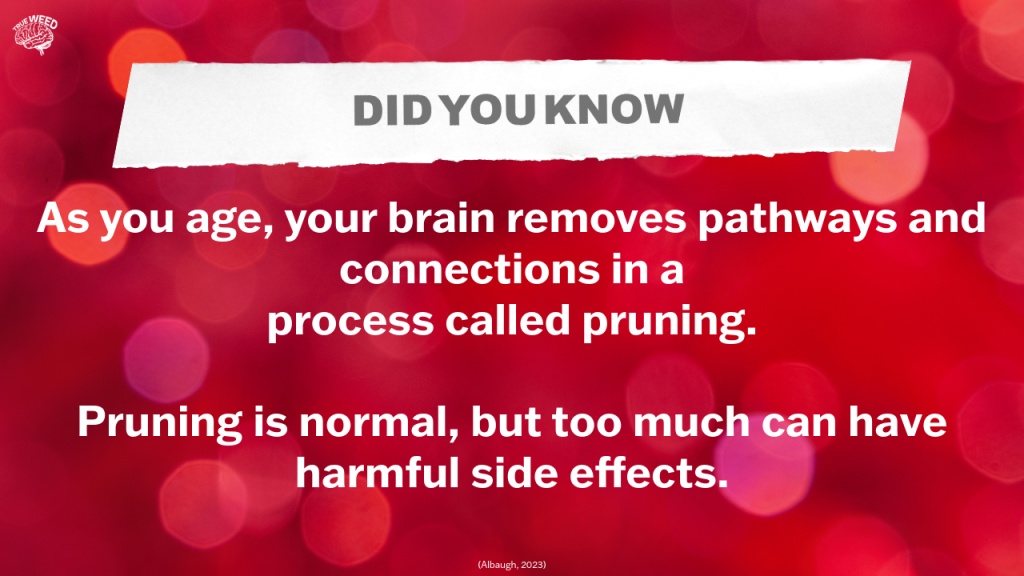
Results: The natural pruning process was accelerated in cannabis users, especially in adolescent initiators. Early users, whose changes were mainly found in the frontal lobe, were more susceptible to start using other addictive drugs like cocaine and ecstasy (MDMA). Starting cannabis use in early adulthood was associated with changes in the thickness of the temporal lobe. This area plays a critical role in processing external experiences, where alterations may predispose users to psychotic symptoms.
Meaning: Cannabis induces excessive thinning in adolescents, which is associated with cognitive impairments.
The changes observed in the brains of adolescent cannabis initiators remained observable later in life, implying that using cannabis during critical periods of development creates an irreversible impact.
Albaugh MD, Ottino-Gonzalez J, Sidwell A, Lepage C, Juliano A, Owens MM, et al. Association of Cannabis Use During Adolescence With Neurodevelopment. JAMA Psychiatry. 2021;78:1–11. https://doi.org/10.1016/j.biopsych.2022.04.017. United Nations Office on Drugs and Crime. World drug report 2018. New York, NY: United Nations publication; 2018.Ferland, J. N., Ellis, R. J., Betts, G., Silveira, M. M., de Firmino, J. B., Winstanley, C. A., & Hurd, Y. L. (2023). Long-Term Outcomes of Adolescent THC Exposure on Translational Cognitive Measures in Adulthood in an Animal Model and Computational Assessment of Human Data. JAMA psychiatry, 80(1), 66–76. https://doi.org/10.1001/jamapsychiatry.2022.3915